

One-page summary of the Enneagram inlcuding types, brief descriptors, motivations, core fears, key defences and the centers of intelligence. Also some key quotes and links.
One-page summary of the Enneagram inlcuding types, brief descriptors, motivations, core fears, key defences and the centers of intelligence. Also some key quotes and links.
Type 1. Can often run out of time in the desire to get it perfect. Find big vision jobs difficult and focus on small “tickable” jobs.
Type 2. Easily distracted by other people’s needs. 2’s can multi-task. The more work they have, the more they can do. They are “pressure prompted”.
Type 3. Highly efficient with their time. Most time management books are written by Enneagram 3s for Enneagram 3s.
Type 4. Need to get themselves into the mood to work. Need to establish a structure, have proper food and sleep.
Type 5. Need to get away from people in order to work.
Type 6. Procrastination in the absence of opposition. Keep refining and improving with great fortitude and endurance for a long time. The only type which likes to be micro-managed.
Type 7. Think they can do more work than they can. They have very busy full days. Often over promise and move fast from one thing to another. They can do a superficial job. To sit in detail is painful.
Type 8. They are very action orientated. Need to structure resting time. When tired they can become agressive and bullying.
Type 9. They will only do something when the conflict of not doing it is greater than the conflict doing it. They need to create false deadlines.
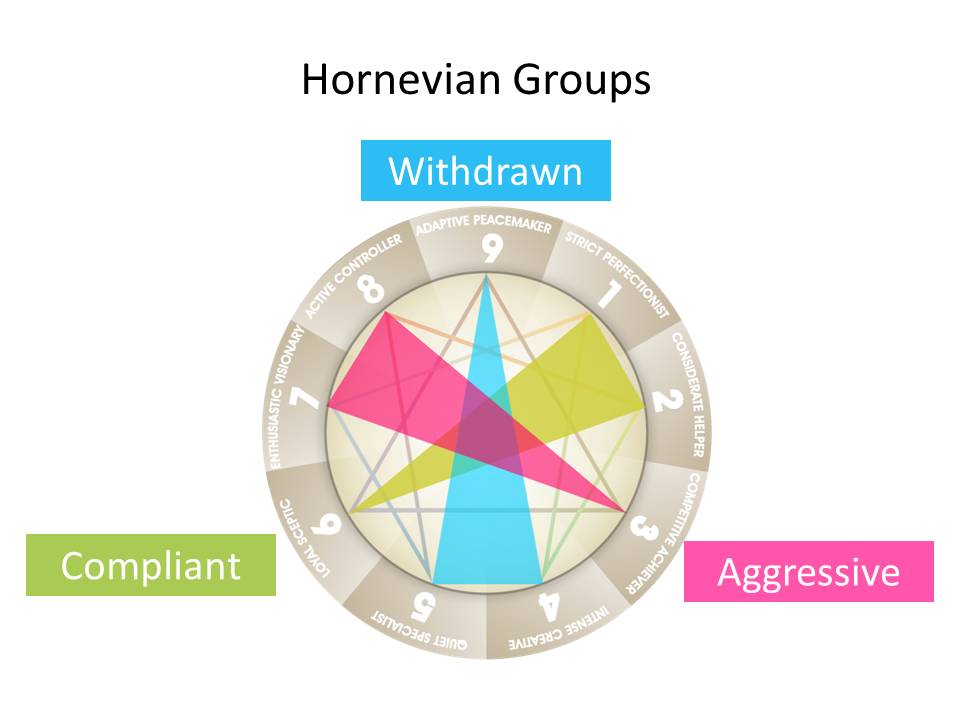 The Enneagram breaks up into threes in mulitple ways. One of these is into the Hornevian triads. This breaks down into:
I developed three leadership styles for each of these:
Go out and get ‘em!
You are confident and daring. You quickly take charge of a situation and are direct and to the point. You have the courage to stand up in front of a large group of people and inspire them. You have lots of energy and are assertive in the world. You have a “can-do” attitude and you like to get things done. You can be quite strategic in the moment depending on what the situation demands.
Use your high energy and boldness to tackle community challenges head on!
Getting it right!
You go by the book. You do proper research and you make detailed plans. You look at the situation from all angles. You patiently work within the rules to change the system. You are good at finishing things. You take responsibility for your actions and insist that other people should too. You tune into people’s needs.
Use your diligence to follow the correct process and get the changes in the community you want.
Thinking out of the box!
You have a deep understanding of the world. You use this to come up with new ideas and ways to do things. You often have a unique way of going about things. You think “out of the box”. You are good at listening and making sure all voices are heard. You are sometimes able to bring stability and calm in a tense time.
Help people understand the deeper issues and excite them with new ideas for change in your community.
Developing social capital amongst South Africa’s youth is key to them finding jobs and developing themselves as people. Good ways to develop social capital are through civic action and volunteerism.
The gap in youth leadership programmes
Interrogating Youth Leadership Development in South Africa is an excellent report by Janet Jobson for DG Murray Trust. It maintains that youth leadership programmes tend to focus on individual self- development skills missing the opportunity to develop social capital. The document explores why we should re-imagine our youth as active engaged citizens tackling key social issues through their own initiative and that they have the potential to lead through public innovation. Citing the TAC and loveLife’s groundBreaker programme, Jobson argues that social capital has been shown to have tangible outcomes for young people in South Africa, for example, in finding jobs.
How to develop social capital
She further argues that social capital is developed through processes such as volunteerism and civic engagement where individuals develop trusting and active connections throughout their communities. “In placing social capital development alongside personal development, innovative leadership programmes can create opportunities for young leaders to….not be tied to one particular network ….but move between groups and become bearers of new ideas, information, and innovation.” The article also quotes cutting edge leadership guru Otto Scharmer in suggesting that “leadership development is not about filling a gap but about igniting a field of inspired connection and action.”
“Everyone should have a holiday”, this is the vision of Heinrich Booysen, 24-year-old River Guide at Gravity Adventures. Booysen, a local from the tiny town of Onseepkans, has spent five years guiding trips for the folks who travel from Joburg and Cape Town. The trips take punters from Onseepkans into a majestic Orange River gorge, Goliath Herons on every corner, and heart thumping rapids. “My job is like a job and a holiday,” says Heinrich, who has a passion for being in nature.
Heinrich now also plans to start his own small business running fishing and picnic trips for the people of his community. “A holiday is not about going shopping at the mall,” he says. “In the Onseepkans community, they think that it is only certain groups of people that do things,” he explains. “I feel bad about it – they have lived all their life along the river and never experienced the Gorge. Yet, anyone can have a holiday and it’s not about the money. I want to win the trust of my people and show them anyone can do it.”
Heinrich describes how many of the people his age in his community of Onseepkans have given up hope of finding a good job and spend their time drinking the wine that is produced locally. “People are scared,” he says. “They are scared of the river. They are scared of talking English. They are shy to communicate with different races. They’ll never talk to people they don’t know.” Heinrich is different. He started out cleaning and packing boats around the Gravity camp with his friend Alex before asking to go on the river. Next thing, he was doing a river guide course and chatting to clients from all over South Africa and the world. He is also studying public management in Springbok. It’s no wonder that Heinrich is something of a hero to the teenagers in Onseepkans who find little other inspiration in the hardships of their small community beset by poverty and isolation.
As a young leader, Heinrich has all the buoyancy of the two-man “croc” inflatable boats Gravity use on the river. “I see a mistake, and I learn from it,” he says. After a difficult break up with a girlfriend he found himself talking to “Big Bunny”, one of the biggest rapids on the stretch. This helped him resolve things and move forward. “Every time you feel down,” says Heinrich, “you should go to a quiet place and talk to nature.”
I watched the Simon Sinek TED talk about how people don’t buy what you are selling or how you made it. They buy the “why”, the purpose behind it. They buy what you believe in. Sinek uses the examples of Apple, the Wright Brothers and Martin Luther King. He says Martin Luther King said, “I have a dream,” not “I have a plan”.
So what do I believe in?
I believe in being intimate with the nitty-gritty of my life. The sweetness of papaya. The strength of my ten year old’s hug. Blending with the dazzle and warmth of the sunset.
I believe in opening to my humanity. I believe in the innate health and creativity of myself and of every other person. I believe in “the levelling of the waters” between me and another, so we are there, beholding each other, one breath at a time. I believe in the ongoing practice of forgiveness – forgiving myself, and forgiving the others.
I believe in shining my light up to the darkness. Standing up to the power that dehumanises, that impoverishes, and that lunges at the heart of the planet for its own greed.
I believe in gaining mastery in something that is chosen. For me, I am going for mastery as a facilitator, as a coach and as a writer. Mastery requires ongoing practice and discipline. It requires finding that balance between effort and ease , between letting go and letting come (to borrow from Otto Scharmer). It requires us to be humble, to be open, and to be paying attention. This is flow!

Enneagram centers of emotion, expression and intelligence could segue onto development levels of egocentric, ethnocentric and worldcentric.
Depending on which practitioner you are engaged with, the centres or triads on the Enneagram can be quite confusing. For instance, Pam Roux, who facilitated my initial Enneagram workshop, referred to the types 8, 9 and 1 as being located in the “anger” centre (1). Riso and Hudson put 8, 9 and 1 in the “instinctive triad.” Others describe this centre as the “action” centre, while Ginger Lapid Bogna places 8,9 and 1 as being in the “body” centre . Ginger, however, also says these centres are not fixed to types, but that any of the types might show up expressing any of the centres. This is a point picked up in a recent article by Lucille Greeff and Dirk Cloete. In the article, they make some very useful distinctions around the Enneagram centres, and they describe three key “perspectives” considering each as equally valid. Their perspective distinctions are particularly interesting as, in my view, they can also relate to levels of human development i.e. pre-conventional, conventional and post conventional (2). So what are the distinctions made by Lucille and Dirk?
Center of emotion — egocentric
First comes the intra personal centre of “structure” which relates to how our “centre’s emotional theme is constructed within us.” This is determined by the structure of the Enneagram. For 8,9 and 1 this would be the “anger” centre with each having a different relationship to anger. Similarly it is the “fear” centre For 5, 6 and 7 and the “shame” centre for 2, 3 and 4. In my view, this would relate to the preconventional or egocentric human development phase where the individual is absorbed with his or herself.
Center of expression – ethnocentric
Second, comes the interpersonal perspective which is a “centre of expression not related to type”. This is concerned with how I interact with others. Lucille and Dirk have an excellent questionnaire which measures how an individual shows up in the world in relation to thinking, feeling and action (I have also included their beautiful representation of the Enneagram in this blog.) This perspective would correspond, again in my view, to the conventional, or ethnocentric stage, where the individual is concerned with a particular group, clan or nation.
Center of intelligence — world centric
Third is the transformational perspective where the triads become “centres of intelligence”. Here Dirk and Lucille reference Roxanne Howe-Murphey. As we become present, these centres in the Enneagram can be described as grounded (8,9,1), connected (2,3,4) or quiet mind (5,6,7). To me this corresponds to the post conventional, or world centric, stage of development where we are capable of identifying with and caring for all sentient beings.
Levels include and transcend each other
It is important to note, as Ken Wilber has done, that these phases include and transcend each other. So, for example, having reached a post-conventional developmental stage, we may well have issues to resolve at a pre-conventional level. Also, each stage is equally valid, and indeed, needed for the overall functioning of the person and society. As Enneagram practioners who are using the centers, linking these perspectives to the stages of development assists us in identifying where and how to start working with the needs and objectives of our clients.
Notes: (1) Each has their own specific relationship to anger with the 9 repressing it, the 8 expressing it, and the 1 “leaking” it. (2) These were first referred to by Kohlberg in his theory of morality development and have subsequently been developed by many other theorists including Ken Wilber.Flow is about effortlessly bringing the whole of ourselves to what we are doing and coming to that doing with sureness and confidence. “When in flow, the individual operates at full capacity,” writes Mihaly Csikszentmihalyi, the psychologist who has pioneered the concept in the field of organisational psychology. “The state is one of dynamic equilibrium. Entering flow depends on establishing a balance between perceived action capacities and perceived action opportunities. The balance is intrinsically fragile.”

For decades elite athletes have been talking about entering “the zone”, a place where time seems to be expanded and they can do no wrong. Of course, this often comes after years of hard work and discipline in their particular field.
Flow is available to us all whether we wait for it to occur spontaneously or whether we dedicate ourselves to its practice. Wendy Palmer, who offers a basic practice for entering the flow state, cautions however that the goal is not to be in flow all the time, but rather to be able to recover at will into a balanced centred state of flow. She writes, “the idea is to become skilled at coming back, not holding on.”
“As we are able to focus on the movement of the mind, we begin to notice that there is space between thoughts. This place of spaciousness is the womb of our creativity. From this still, calm place comes our inherent wisdom: the knowledge of our intuition with an understanding of what is needed for clear and compassionate action.”
We are listening to a book read and written by James Hollis called “The Middle Passage” which title denotes our passage to full adulthood prompted by a call of our psyche for authenticity in our middle age. Chapter One covers fairly familiar ground for those grounded in a psychological/coaching paradigm albeit from a Jungian perspective – i.e. we are with our particular lenses because of how we have been raised by mom and dad. Our personality has evolved as a defence by ourselves as children when we were overwhelmed by life or else hurt in some way. The defence is limiting because it was formed by us as very small children with very limited means of interpreting the world.
Hollis quotes lots of poetry and recalls some of our great artists over the centuries who have expressed this bind we find ourselves of living out a life not of our conscious choosing. With this as his theme, Hollis writes about the ‘tragic flaw’ in the heroes of the old Greek tragedies and he renames this as ‘wounded vision.’ Of course this is also a beautiful reframing in that it offers the opportunity for healing and purposefully adjusting or vision — surely what is to come in the rest of the book…..
How do we do the big work and stay and expansive and inclusive – even under stress? Wendy Palmer’s work on conscious embodiment is profound. She teaches a centering practice to consciously make use of our larger energy field or “peri personal space” and include everyone in it. The practice is to position our advocacy and our listening within the energy that surrounds us rather than have it constricting up our bodies. It is about allowing our advocacy to come through us unedited by the mind or mediated by the personality. This is the experience of flow. She emphasises over and over again however that the goal is not to be in a permanent state of flow. The practice is to recover into it from imbalance or stress. I am lucky enough to be attending a two day workshop right here in Cape Town with Wendy Palmer herself.
