
At the edge of his inner vision, behind his closed eyes, he senses something in the act of becoming. It will arrive with morning light; something shifting and breathing, its form disguised in a copse or grove. HILARY MANTEL
In the act of becoming
How brave we are
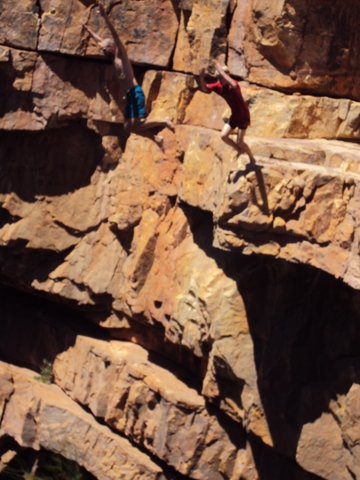 Deep in the Cedarberg mountains, deep in a valley, lies a deep pool surrounded by high rocks. Why would we shed our comfortable clothes and stand near naked on the cliff, willing ourselves to step off into the drop?
A moment of free-fall and the plunge, pulled even deeper down, and darker, some split seconds of not knowing and then partial churning sight of translucent beer bottle brown. The fullness of ourselves kicking us up into breathing bright full-coloured breaths upon the surface.
We do it to remind ourselves how brave we really are.
Conflict
Do you run or do you fight? Conflict, or more specifically our ability to be with it and navigate it, comes up again and again in every relationship, in every family, in every team. I’m a runner — my natural instinct is to withdraw until the storm has brewed over — and it’s taken me years to see the value of conflict and embrace it as necessary to my growth and that of the team. Other personalities have an appetite for conflict, or at least don’t shy away from it, but their learning is to realise and mitigate the impact of their anger or forthrightness.
Without conflict we stay in the polite stage of things with people. Everyone is on their best behaviour but this is dull and generates nothing because we are not coming out with what we really think and feel. When people start listening to themselves and finding their own voice, conflict is possible. But people also get real and authentic with each other. This not only makes things more interesting, it allows people to show up with all of themselves and ultimately contributes to a richer quality of being — and of course, a high performing team.
Here is my check list for when I see a storm on the horizon:
- be willing to go into conflict
- be willing to “see” and “be seen” (see the other person’s point of view; speak up for my own point of view)
- let go of being right and of what happened in the past
- focus on a solution or a way forward
We’ll be alive again in a thousand blades of grass
Philip Pullman’s “His Dark Materials” Trilogy features other worlds where our protagonists have “daemons” — essentially a part of themselves expressed in animal form. Inhabitants of these worlds have long observed the phenomenon that when they die, their daemons simply evaporate into the air. In this excerpt, Lyra, our chief protagonist, explains to the ghosts in the land of the dead what happens when you die:
“This is what’ll happen,” she said, “and it’s true, perfectly true. When you go out of here, all the particles that make you up will loosen and float apart, just like your daemons did. If you’ve seen people dying, you know what that looks like. But the daemons en’t just nothing now; they’re part of everything. All the atoms that were them, they’ve gone into the air and the wind and the trees and the earth and all the living things. They’ll never vanish. They’re just part of everything. And that’s exactly what’ll happen to you, I swear to you, I promise on my honour. You’ll drift apart, it’s true, but you’ll be out in the open, part of everything alive again.”
 She finds support from someone in the crowd… “Even if it means oblivion, friends, I’ll welcome it, because I won’t be nothing, we’ll be alive again in a thousand blades of grass, and a million leaves, we’ll be falling in the raindrops and blowing in the fresh breeze, we’ll be glittering in the dew under the stars and the moon out there in the physical world which is our true home and always was.”
(The drawing is of Lyra and her daemon Pantalaimon in his favourite form of an ermine.)
16 October was the anniversary of the death of my beloved grandmother, Lorraine Mahoney, whose spark and love I continue to feel in the white waves charging to the shore, in the sun lighting up the mountain and the iridescence of the sunbird’s wing.
Lighten your load
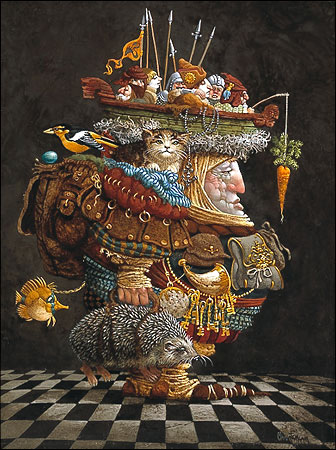 This picture was painted by American fantasy artist, James Christensen who was feeling weighed down by all his responsibilities. Of the picture he said “I discovered that my burdens were really blessings and challenges necessary for my growth.” The value of discernment is important here because when we carry too many “shoulds” and expectations, especially if these come from others they can make us so heavy we don’t have the lightness to be present, nor do we have the energy for our own dreams.
Start close in by David Whyte
START CLOSE IN
Start close in, don’t take the second step or the third, start with the first thingclose in, the step you don’t want to take.
Start with
the ground
you know,
the pale ground
beneath your feet,
your own
way of starting
the conversation.
Start with your own
question,
give up on other
people’s questions,
don’t let them
smother something
simple.
To find
another’s voice,
follow
your own voice,
wait until
that voice
becomes a
private ear
listening
to another.
Start right now
take a small step
you can call your own
don’t follow
someone else’s
heroics, be humble
and focused,
start close in,
don’t mistake
that other
for your own.
Start close in,
don’t take
the second step
or the third,
start with the first
thing
close in,
the step
you don’t want to take.
Saint Gilbert between the wolves
One of the elders told him that when he was a boy his grandfather came to him one day and said he had two wolves fighting inside him. One was gray, the other black. The gray one wanted his grandfather to be courageous, and patient, and kind. The other, the black one, wanted his grandfather to be fearful and cruel. This upset the boy and he thought about it for a few days then returned to his grandfather. He asked, “Grandfather, which of the wolves will win?”
The abbot smiled slightly and examined the Chief Inspector. ‘Do you know what his grandfather said?’
Gamache shook his head. There was a look of such sadness on the Chief Inspector’s face, it almost broke the abbot’s heart.
‘The one I feed,’ said Dom Philippe.
Gamache looked back at the monastery that would now stand for many generations to come. Saint-Gilbert-Entre-les-Loups. He’d mistranslated it. Not Saint Gilbert among the wolves, but between them. In that place of perpetual choice.
From the Beautiful Mystery by Louise Penny (2012)
Purpose
To work with these questions:
- how can we live in integrity with ourselves and our humanity?
- how can we trust more in grace, in love, in the intelligence of the cosmos?
Home
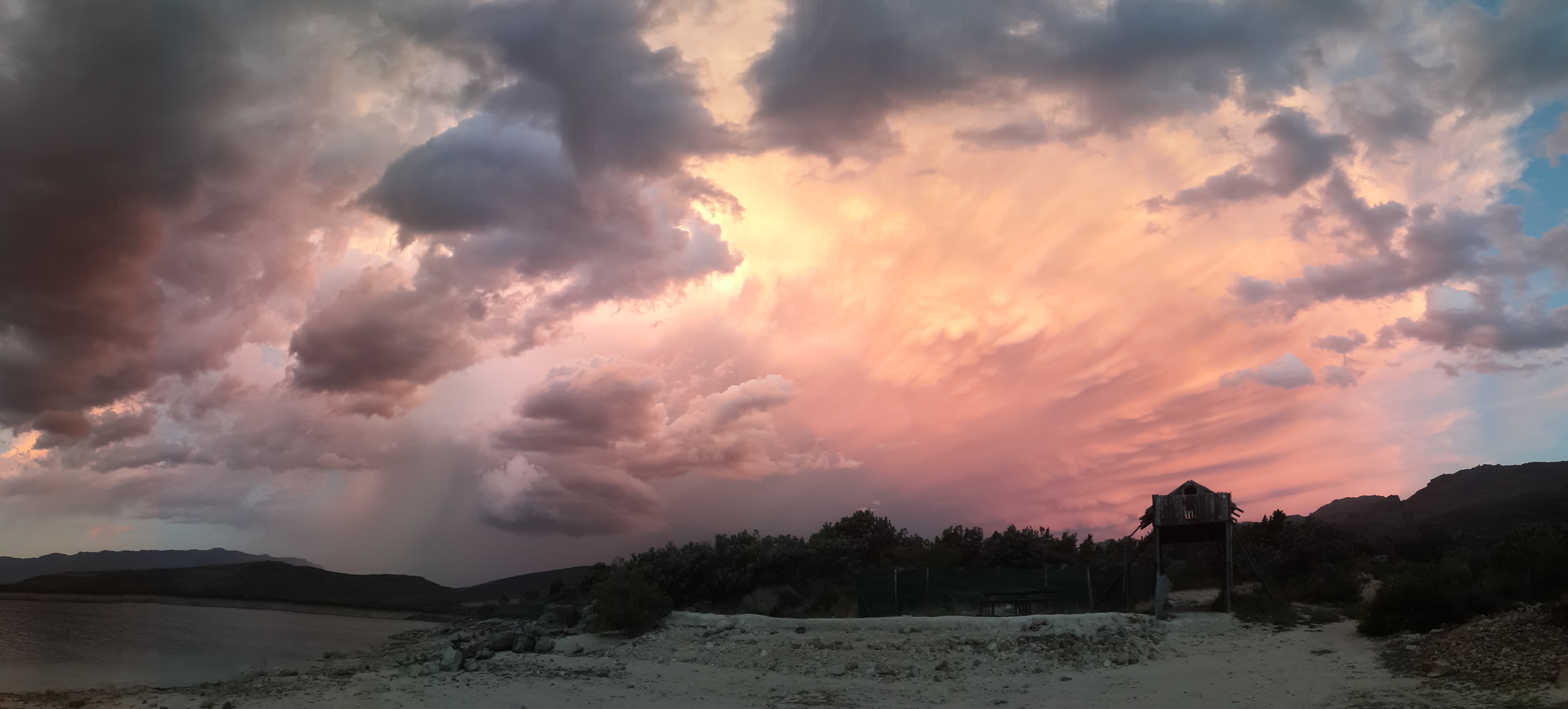
Some places call us back and back again. Here we remember ourselves and what we love: Mountains, rivers, stillness. Here we spend easy time with the people we love: Swimming together, fireside-chats, poytjies. Here we are surprised by new kinds of magic — like the dramatic sky of this summer storm. Thank you Eselfontein!
Sadness
“It seems to me that almost all our sadnesses are moments of tension, which we feel as paralysis because we no longer hear our astonished emotions living. Because we are alone with the unfamiliar presence that has entered us; because everything we trust and are used to is for a moment taken away from us; because we stand in the midst of a transition where we cannot remain standing. That is why the sadness passes: the new presence inside us, the presence that has been added, has entered our heart, has gone into its innermost chamber and is no longer even there, – is already in our bloodstream. And we don’t know what it was. We could easily be made to believe that nothing happened, and yet we have changed, as a house that a guest has entered changes. We can’t say who has come, perhaps we will never know, but many signs indicate that the future enters us in this way in order to be transformed in us, long before it happens. And that is why it is so important to be solitary and attentive when one is sad: because the seemingly uneventful and motionless moment when our future steps into us is so much closer to life than that other loud and accidental point of time when it happens to us as if from outside. The quieter we are, the more patient and open we are in our sadnesses, the more deeply and serenely the new presence can enter us, and the more we can make it our own, the more it becomes our fate.”
― Rainer Maria Rilke